Corrie’s links with Ireland have existed since the beginning with one of the original characters, Concepta Riley, hailing from Ireland. She regularly appeared until 1964 and made guest appearances in 1967, 1972 and 1975.
The most famous Irishman on the street has been Jim McDonald. Loved for his accent and quirky Irish sayings, Jim has become a firm favourite with viewers.
Other Irish links include barman and chef Ciaran McCarthy who was played by Boyzone’s Keith Duffy.
Paul, Liam and Michelle Connor’s parents Barry and Helen are Irish and live in Ireland although none of the children have an Irish accent. Unless they were brought up in Manchester and then the senior Connors returned to their native island.
Elsie Tanner had two Irishmen as lovers: Jim Mount (1965-66) and Ron Mather (1978-9).
And when Concepta visited in 1972 and 1975, she was accompanied by her fiancée and later second husband Sean Regan. Upon his visit, Sean made a pass at Bet Lynch.
And a piece of trivia for you: Sam Kydd, who played Mike Baldwin’s Cockney wide-boy dad Frankie, was an Irishman!
And a member of our blogging team, Emma, is also Irish!
I wonder if they'll be celebrating St. Patrick's Day in the Rovers Return tonight in Corrie?
As it's election day here in the UK, I thought I'd re-post this blog about political life and links in Weatherfield.
Although Corrie has often avoided real politics in its script, mainly because it wouldn’t be current due to episodes being filmed weeks ahead of broadcast, it has had included politics in some of its storylines and we often get a glimpse of the political stance of certain characters.
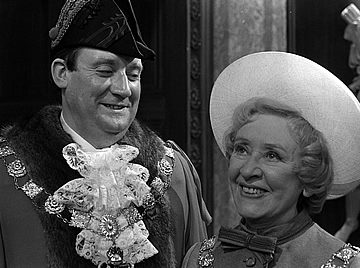
Many characters have involved themselves in local politics. We mentioned Alf Roberts previously, and he is the most prominent local politician. A long serving councillor and twice-elected mayor, Alf was given an OBE by the Queen in 1995 for his services to the community. Alf was an independent councillor and during his 1991 election campaign, his posters wrongly called him ‘The People’s Fiend’ instead of friend. He was a mayor in 1973 and 1994. His first mayoress was Annie Walker, although she was only given the post after Maggie Clegg refused. When he was chosen in 1994, wife Audrey was his mayoress. But when she abused the mayoral privileges, Alf sacked her and offered the post to Rita Sullivan. When Audrey heard this she threatened to spread rumours that Alf and Rita were lovers. Alf then opted for Betty Turpin, despite Bet Gilroy hoping she’d be chosen. The council showed their appreciation of Alf’s contribution when they chose him to be responsible for the millennium celebrations in 1997 and he was nicknamed ‘Mr Millennium’. In 1998, Alf resigned from the council so he could concentrate on the millennium preparations. But in 1999 he passed away before the arrival of the millennium.
As well as Alf, other characters have involved themselves in political life. Between 1966 and 1978, Len Fairclough was a councillor and beat Annie Walker to the post in 1966. Alf and Len were best mates and their friendship was tested when they both contested for the role of mayor in 1973. Alf won and offered Len the role of deputy mayor. Len’s time as councillor ended when he was forced to resign after he was arrested for being drunk and disorderly. Despite not having won the 1966 election, Annie Walker was in her element as Alf’s mayoress and indulged in the privileges of the job.
In the 1987 election, Alf was challenged by Deirdre Barlow, after she was urged by hubby Ken to stand so to split the vote. But to Ken’s amazement, Deirdre beat Alf. Suddenly, the Barlows became a high-powered couple – him a newspaper editor and she a councillor. Ken and Deirdre split up after his affair with Wendy Crozier (who also worked at the council and leaked stories to Ken) in 1990 and in 1991 Deirdre lost her seat to Alf, who’d been encouraged by Alec Gilroy to stand again. Ken had supported Deirdre in the 1991 election and clashed with Alf when he put a ‘Vote Deirdre’ in the corner shop flat where he lived after being thrown out by Deirdre. As well as being a councillor, Deirdre worked at the council in administration for over ten years from the late 1990s.
When Alf resigned from the council in 1998, thus began a battle of who was going to fill the empty seat. His wife Audrey stood against eco-warrior Spider Nugent and won the seat. During her time as councillor she was elected mayor in 2000 and got the chance to meet HRH Prince Charles, the Prince Charles and enjoyed gloating about it. In 2001, due to best friend Alma’s illness, Audrey backed out of being re-elected and let Curly Watts win the vote. Curly remained at the council until he left Weatherfield for Newcastle in 2003.
Politics has also entered other characters’ storylines in different ways. The future of Coronation Street was in the balance in 1974 and many of the residents opposed the council’s decision to demolish the place. And many were disgruntled when they heard that Alf and Len knew about it and didn’t say anything. Timid Emily Bishop threw a brick through Len’s window in protest. The street was eventually saved. Then a few decades later, the council thought of renaming the street ‘Alf Roberts Wynd’ in honour of Alf, but yet again the residents opposed. In 2004, the council planned to erect a fountain in memory of Alf, but Emily, Betty, Rita, Norris and Blanche held a protest against it, much to Audrey’s chagrin.
As for political stances, the most prominent has to be Ken Barlow who is a staunch Liberal who reads ‘The Guardian’. Ironically, William Roache, who plays him, is a staunch Tory! During the 1970s you often saw Ken, Ernest Bishop and Annie Walker discussing the politics of the day with references being given to Jim Callaghan, Harold Wilson, Denis Healey and Margaret Thatcher. And Mrs Thatcher, Tony Blair and Ed Miliband have visited the Corrie set over the years.
Can you think of any other political links? Do you think Corrie should have a political storyline – a threat to close the hospital maybe? Or maybe a character becomes a councillor?
And what about the political stances of certain characters? Who do you think supports the Tories, Labour or the Liberals? Leave your comments!
How many of you know who was Miklos Zadic? And how many remember him? I certainly don’t – he appeared 23 years before I was born!
Zadic, along with Jimmy Gibson, was responsible for overseeing the demolition of the Mission and Elliston’s Raincoat Factory in early 1968. The demolitions went smoothly apart from when the Barlow twins wandered into the site before the bulldozers moved in to demolish the factory. Miklos halted the machines and helped Ken to carry them out safely.
Miklos Zadic hailed from Hungary and when he entered the Rovers, he caught the eye of many of the street’s womenfolk – mainly Lucille Hewitt. However it was with another woman that Miklos would be associated with and that woman was, surprisingly, spinster Miss Emily Nugent. They’d been set up on a date by Emily’s pals Val and Irma Barlow. An unlikely pairing, they hit it off. Miklos was passionate while Emily was more conservative and didn’t believe in sex before marriage. After unsuccessfully leading Emily into bed, he decided to respect her beliefs and distanced himself from her. As the demolition had ended, he planned a transfer to Newcastle but planned to holiday in Scotland first. He asked Emily to join him and she accepted, knowing they’d have sex. Emily returned alone (Miklos had gone to Newcastle), a virgin no more and had no regrets. She later moved into the Rovers with the Walkers.
As well as his romance with Emily, Miklos’ other storyline included being accused of stealing Albert Tatlock’s coin collection. Oh, how Corrie’s crimes have changed since then! Albert had shown Miklos the collection only for Albert’s house to be burgled soon after. It was later revealed that a worker from the building site was responsible.
Miklos Zadic was played by Greek Cypriot Paul Stassino, born in 1932. He moved to the UK in 1952 and entered RADA. His credits included Thunderball (1965) and The Saint. He returned to Cyprus in the 1970s and acted and directed in the theatres there. He stayed in Cyprus and retired there and died in 2012 in Limassol.
Sadly, the possibility of Miklos visiting Emily in the future is very unlikely. And I always thought it’d be nice that she’d open the door and find him on the doorstep. He’d sure put Norris’ nose out of joint!
And there you are – the end of our A-Z feature. I hope you’ve enjoyed reading the posts and voting in the polls as much as I enjoyed researching and writing them.
Stay tuned for my next project in the next few weeks.
YouTube – a haven for Corrie fans! Since 2005, we have been able to watch or upload clips and episodes of Corrie – from the 1960s to the present day.
There are fabulous channels that include classic Corrie episodes – be it from episodes recorded on old VHSs from Granada Plus, ITV or CBC. Then there are episodes of the video series profiling various Corrie characters up to the early 1993, titled ‘The Coronation Street Collection’. Characters profiled include Ken, Deirdre, Rita, Emily and Mavis, Bet, Annie, Len and Elsie, Alf and Audrey and Ena, Minnie and Martha.
My favourite Corrie channel has to be mrmagister1. He’s got great episodes from the 1970s up to the 1990s.
Have you got favourite Corrie clips on YouTube or a favourite Corrie channel?
Due to a lack of words beginning with ‘x’ that are linked to Corrie, forgive me for using the word ‘xtra’, minus the ‘e’. Sorry to those who are particular about their spelling!
As we know, Coronation Street is extra special. If it wasn’t, we wouldn’t be watching it, and certainly we wouldn’t be writing countless posts about it!
What makes Corrie extra special for me compared to other TV shows is: its history, its sense of familiarity (the show’s been blessed with long running characters over the years), its mix of drama and humour and of course its great characters (that are seen in the collage above).
Weddings are popular wherever they are – be it at your local church or if they’re royal weddings like Price Albert of Monaco and Grace Kelly, Charles and Di or Wills and Kate. And soap weddings, and Corrie weddings in particular, are no different.
The first Corrie wedding was Jack and Annie Walker’s daughter Joan marrying Gordon Davies in March 1961, four months after the show first aired. But Gordon and Joan weren’t regulars, so the first regulars to marry were Harry Hewitt and Concepta Riley who married in October that year.
During the 1960s, there were seven other weddings – the biggest being Elsie Tanner’s wedding to old flame Steve Tanner (writers were determined to keep Elsie’s surname!). This was the first wedding to show the actual wedding ceremony. Previous weddings had only shown the bride and groom leaving the church and the reception. This wedding garnered huge press publicity and was dubbed ‘Wedding of the Year’ in the TV Times. The wedding episode from September 1967 is the second most repeated episode in Corrie’s history – behind the first episode. But the wedding day was tinged with sadness due to the death of Harry Hewitt when he was crushed by a van. Do you remember watching the wedding?
Elsie was also the first bride of the 1970s – her third wedding to Alan Howard occurred in July 1970 and was the first Corrie wedding in colour. There were also seven other weddings during the 1970s (although Ken Barlow and Janet Reid’s wedding in 1973 was unseen). It was the wedding of Len Fairclough and Rita Littlewood in April 1977 that was the most watched episode of Corrie during the 1970s and signalled the beginning of a golden era for the soap after a slump in the early 1970s. 20.9 million watched the episode. Do you remember watching that wedding?
Emily Bishop was the first bride of the 1980s – marrying bigamist Arnold Swain in September 1980. Viewers had seen Emily marry for the first time eight years previously to Ernest Bishop – the most watched episode of 1972. It seems that the wedding of the decade and indeed one of Corrie’s legendary weddings occurred in July 1981 when Ken Barlow married Deirdre Langton. What brought much publicity to the wedding was the fact that it occurred two days before the wedding of Prince Charles and Lady Diana Spencer – the biggest royal wedding to date. Also, both Ken and Deirdre were a popular couple and still are. Another big wedding of the 1980s was when Mike Baldwin married Susan Barlow. As well as the 23 year age gap, the other big problem was the rivalry between Mike and Susan’s dad Ken. Ken’s decision to walk his daughter down the aisle at the last minute brought much dramatic effect which attracted over 18 million viewers. The marriage lasted a year. In 1987, we saw Bet Lynch finally marry. But not to her usual ‘type’. Bumbling and tight fisted Alec Gilroy was an unlikely partner to Bet and many viewers protested outside the church where they filmed the wedding. The wedding went ahead and the Gilroys became one of those classic Corrie couples. While viewers and Bet’s friends like Betty and Rita were sceptical of the partnership, it lasted for five years.
The 1990s saw twenty weddings (although not all onscreen). The biggest weddings of the decade include Martin Platt and Gail Tilsley in November 1991, Reg Holdsworth and Maureen Naylor in January 1994, Curly Watts and Raquel Wolstenhulme in December 1995 and Ashley Peacock and Maxine Heavey in September 1999. Although they weren’t legally married, the union of Roy Cropper and Hayley Patterson in April 1999 was hugely popular. They were finally allowed to marry in August 2010.
Since the turn of the millennium, there have been thirty weddings – look at the difference from the 60s and 70s!! The biggest weddings include Mike Baldwin and Linda Sykes in September 2000, Richard Hillman and Gail Platt in July 2002, Steve and Karen McDonald in February 2004, Dev Alahan and Sunita Parekh in October 2004, Ashley Peacock and Claire Casey on Christmas Day 2004, Ken Barlow and Deirdre Rachid in April 2005 (a day before Prince Charles married Camilla Parker-Bowles), Les Battersby and Cilla Brown in November 2005, Liam Connor and Maria Sutherland in February 2008, Steve McDonald and Becky Granger in August 2009 and Dennis Tanner and Rita Sullivan in June 2012.
What’s your favourite wedding? Vote in the poll below!
Corrie has had its fair share of villains over the years and each have kept viewers on the edge of their seats.
The first villain I believe was Joe Donnelli, who murdered Elsie Tanner’s second hubby Steve in 1968 and who held Irma Barlow and Minnie Caldwell hostage and held Stan Ogden at gunpoint in 1970. He shot himself in the end.
For the next 18 years or so, Coronation Street didn’t have any villains – apart from the odd burglar, robber and wife beater. Then Alan Bradley came to the fore. Introduced in 1986 as the dad of Jenny who became Rita Fairclough’s boyfriend, Alan became villainous in 1988 when he stole from and cheated on Rita. It was established that he had a temper, but nonetheless it was a shock when he stole Rita’s house deeds and impersonated her dead hubby Len. When she found out in 1989, he tried to kill her by suffocation. He was arrested and imprisoned until he appeared in court and got scot free. He returned to Weatherfield to terrify Rita by visiting her when she was alone and intimidating her and taking away her self-confidence. She suffered a breakdown and fled to Blackpool. Alan went after her and while chasing her on the promenade, he was hit by a tram. Rita’s nightmare was over.
While Corrie and EastEnders are very different soaps, I’m afraid Corrie did copy EastEnders with one character. While Terry Duckworth had first appeared in 1983, by the 1990s he’d become similar to EastEnders’ Nick Cotton – a sinister character who relished in hurting his family and neighbours. He often returned to the street to con his parents and even to sell his own son!
In the late 1990s, con men ruled the street. In 1997, Deirdre Rachid met charming ‘pilot’ Jon Lindsay. But as we know, Jon worked in an airport tie shop. Although he’d lied to her, Deirdre made the mistake of sticking with Jon and they planned to marry. But Jon had committed huge fraud and had included an unwitting Deirdre in his crimes. Jon had managed to avoid being accused while Deirdre was left to face the music. Jon’s actions led Deirdre to court and prison. But another woman who Jon had also conned and even married came forward and Deirdre was released. While poor Deirdre recovered, another Corrie woman fell for a conman’s charms. Sally Webster fell for Greg Kelly’s charms. But Greg was aware that she had inherited a lot of money after her mother’s death. He managed to manipulate Sally into investing in his new business but quickly turned nasty and assaulted her and kept her and the girls hostage. She eventually escaped his clutches and he was jailed.
At the turn of the millennium, Corrie’s villain was drug dealer Jez Quigley who made Steve McDonald and Leanne Tilsley’s lives hell and who was behind the death of Tony Horrocks and the manslaughter of Des Barnes in 1998. Jez and his henchmen nearly killed Steve after he testified against him at his trial for Tony’s murder, and dad Big Jim sought revenge by attacking Jez. Although Jez survived the attack, he later died from a punctured lung while attempting to smother Steve in 2000. Big Jim was sent to prison for manslaughter.
The next villain on the street is my all-time favourite – Tricky Dicky – Richard Hillman! Introduced as the cousin of Alma in 2001, he quickly charmed Gail Platt and eventually married her. But behind the family man hid an evil man. He left Duggie Ferguson for dead, hit his ex-wife Patricia with a spade, tried to kill mum-in-law Audrey and Emily Bishop and killed Maxine Peacock. And all because of money – well, apart from Maxine – she just knew too much! When he was cornered, Richard kidnapped his family and drove them into the canal. He was the only one who perished.
While Richard was trying to smother Emily on Christmas Day 2002, Tracy Barlow returned to the street and became the local bitch – ruining the marriages of Steve McDonald to both Karen and Becky and murdering Charlie Stubbs. Other Corrie bitches during the 2000s include Cilla Brown who neglected her son Chesney and tried to ruin Rita’s life by falsely accusing her of GBH; and Maya Sharma who was a love interest of Dev Alahan’s and when he dumped her for Sunita, she reacted badly by putting all of his seven shops on fire, and keeping Dev and Sunita hostage above a burning corner shop. When she found that they’d survived, she attempted to drive them down but was hit by a lorry and admitted to a mental hospital.
Builder Charlie Stubbs was a control freak who manipulated girlfriend and later fiancée Shelley Unwin by telling her she should lose weight and then making her agoraphobic. She accepted his marriage proposal but when she reached the altar she dumped him – much to the delight of her mum Bev. Charlie then moved on to Tracy Barlow but made the mistake of having an affair with Maria Sutherland. Tracy sought revenge by making out that Charlie was abusing her before hitting him on the head with a statue that eventually kills him. Tracy was imprisoned for his murder.
Demonic David Platt is another Corrie villain of late. He was traumatised by his stepfather Richard Hillman and sought revenge on his mother Gail for bringing him into their lives. He sent her cards, seemingly from Richard. And in 2008 he pushed her down the stairs when he found out she told Tina McIntyre to abort David’s baby. He also vandalised the street and assaulted many people and was sent to youth detention. He led a quiet life after that, marrying Kylie Turner. But then in 2013 he found out about Kylie’s affair with brother Nick and sought revenge by making a hate campaign against Nick.
Tony Gordon was introduced as a business client of Underworld’s and became a business partner. He soon became unpopular when he planned to expand the factory and attempted to convince both Rita and Kevin to sell their businesses. While Rita was willing, Kevin was not. Tony then enlisted someone to sabotage the garage’s business. He also bullied pensioner Jed Stone to sell his house so he could redevelop the site. He became engaged to Carla Connor and when he found out she was having an affair with brother in law Liam, he arranged for Liam to be run over and killed. Tony and an oblivious Carla later marry. Carla confessed about the affair and Tony also confessed that he’s a murderer. Carla fled to Los Angeles. Tony then became involved with Liam’s widow Maria and they become engaged. While Maria was away, Tony suffered a heart attack and thinking he was dying he confessed to Roy Cropper about his misdeeds. When he survived, Tony tried to silence Roy by pushing him into the canal. Having a crisis of conscience, Tony jumped in and saved Roy and handed himself to the police and was imprisoned. But months later he escaped and held Carla and Hayley hostage at Underworld. He released Hayley before setting the factory on fire, determined to kill Carla and himself. Carla managed to escape and Tony perished.
John Stape was a very different baddie compared to the likes of Hillman and Gordon. Stape was a hapless villain – he didn’t mean to kill the people he did. His first misdeed was kidnapping Rosie Webster and holding her hostage at his gran’s house. He was imprisoned for that but married Fiz Brown in prison before being released and trying to rebuild his life. But yet again, John went down the wrong path. He committed identity fraud (pretended to be Colin Fishwick); he covered up the death of the real Colin (who collapsed of a heart attack during an argument); he suffocated Colin’s mum Joy; he murdered Charlotte Hoyle when she threatened to expose him; and held Charlotte’s parents and Chesney hostage in a cellar. John then went on the run before crashing his car and he died in hospital. But many of the situations he got himself to were hilarious and used a lot of black humour.
In the last few years, villains have included the likes of Lewis Archer (who stole money from the bookies and from Gail McIntyre); Frank Foster (who raped Carla Connor and ousted her from the factory); Kirsty Soames (who abused and manipulated partner Tyrone Dobbs and falsely accused him of abusing her!); and Karl Munro (put the Rovers on fire and killed Sunita Alahan).
Who’s your favourite villain? Vote in the poll below. And if you haven't, you can vote for your favourite moment from Corrie in the 1960s here. Voting closes at midnight tonight.
We all have our favourite tipple when we go to the pub or out for a meal – me, it’s an appletiser. And the residents of Coronation Street are no different. Many a time when the punters enter the Rovers, you can hear the barmaids asking “Usual?”.
Rita’s known for her fondness of vodka and tonic while Audrey likes her gin and tonic. Deirdre enjoys a glass of red wine, although I can’t recall what her tipple was in the early days. Anyone remember?
Hilda Ogden, Ivy Tilsley and Phyllis Pearce indulged in a bottle of lager with a glass while Elsie Tanner was seen with a glass of gin and tonic. And of course Ena Sharples, Minnie Caldwell and Martha Longhurst were seen supping milk stout in the snug.
Many of the menfolk of the cobbles like Alf Roberts, Len Fairclough, Jack Duckworth, Steve McDonald and Stan Ogden enjoyed a pint of bitter while Ken Barlow and Norris enjoy a half of bitter as did Percy Sugden. Albert Tatlock’s favourite tipple was a rum and often got the other punters to buy it for him!
Emily Bishop likes her sherry while Mavis Riley enjoyed a pineapple juice and Becky Granger liked her snakebite shandy. Roy and Hayley Cropper enjoy an orange juice at the Rovers.
Be it ‘Her Indoors’ in ‘Minder’ or Mrs Columbo, unseen characters are often featured (although we never see them!) in TV shows. And Corrie is no exception. Here’s a list of the some that have come to my mind:
Nellie Fairclough/Bailey – Len Fairclough’s first wife. Len had appeared since 1961 but Nellie was never seen. They divorced in 1963 so she could marry Harry Bailey but she died in 1964 of lung cancer.
Fat Brenda – works the switch at Streetcars and is also a cabby and is frequently mentioned by Steve, Lloyd and Eileen. She also contributes to this blog and her posts are very popular and much appreciated!
The woman from 19 Inkerman Street – Stan Ogden’s lady friend, who infuriated Hilda. When Stan didn’t come home one night in 1976, Hilda suspected he was round at Inkerman Street. Bet Lynch and Elsie Tanner enjoyed winding Hilda up with this.
Tony and Sylvia Ogden – The Ogdens children who didn’t come to live in Coronation Street and never visited.
Phyllis Roberts – Alf Roberts’ first wife who died in 1972.
Mr Papagopolous – Swindley and Miss Nugent’s boss at Gamma Garments during the 60s and possibly the husband or father in law of Wendy Crozier. A precursor to EastEnders’ Mr Papadopolous, who runs the launderette.
Without a doubt, Coronation Street’s theme tune is one of the most recognised in the whole world. The brassy theme tune, consisting of a cornet, brass band, clarinet and double bass, is reminiscent of the brass bands of the North West of England. It was composed by Eric Spear (1908-1966).
The identity of the trumpeter was not public knowledge until 1994 when they were revealed as Ronnie Hunt. Hunt, pictured, said he’d been paid £6 and stated that Spear insisted on having many takes before finding the sound he wanted.
In 2010, a new completely re-recorded version of the theme tune. But for me, this is the theme tune of Coronation Street!
What do you think of the current theme tune? Did you prefer the old one?
As we all know, this was the decade that our favourite show began! First airing on the 9th of December 1960, the show was only commissioned for thirteen episodes but viewers were immediately drawn to the serial set in Manchester, despite no critical acclaim. Viewers enjoyed watching the ins and outs of ‘ordinary’ working-class characters, something that hadn’t been portrayed on television before. The show also made use of the Lancashire dialect of ‘eh chuck’ and ‘nowt’ and suddenly another dialect was heard on TV screens apart from the Queen’s English. The serial consiste
d of 21 original characters, which you can read about here.
Storylines in the early years included Ken Barlow battling against his working-class background. Ken was one of the few characters to have gone to university and symbolized the growth of globalization and the decline of communities. His clashes with his dad Frank and Len Fairclough caused tension in the early years of the show’s history. Another early storyline was the rivalry between battleaxe Ena Sharples and street siren Elsie Tanner. They had two memorable showdowns: in 1961 when Elsie accused Ena of sending her a poison pen-letter and in 1965 when Ena, as Elsie’s new landlady, attempted to evict her. Other characters who were involved in storylines during the early 1960s included Jack and Walker, Harry and Concepta Hewitt, Minnie Caldwell, Martha Longhurst, Leonard Swindley, Emily Nugent and Christine Hardman.
In 1964, new producer Tim Aspinall decided that the show needed a shake-up (a precursor to Brian Park if you like) and decided to axe several characters. The biggest casualty was Rovers cleaner Martha Longhurst, who occupied the Rovers snug with fellow OAPs Ena and Minnie. Viewers and cast-members alike protested against the axing of Martha but they were defeated and Martha died of a heart attack in the snug. But while the show lost a popular character, it gained two characters that would become Corrie legends: Stan and Hilda Ogden!
Coronation Street immediately won over the viewers and by March 1961 had reached the No. 1 slot and remained there for the rest of the year. Around 15 million regularly watched the show, which was about three quarters of the audience. By 1964, the programme attracted over 20 million viewers.
For the remainder of the decade, storylines included the marriage of Ken and Valerie Barlow that included the birth of their twins Peter and Susan in 1965 and Valerie being kept hostage by rapist Frank Riley in 1968; the various liaisons of Elsie Tanner that included her wedding to old flame Steve Tanner that was a huge ratings winner in 1967; the train crashing off the viaduct to the street in 1967; the murder of Steve Tanner in 1968; and a coach crash in 1969.
Despite its huge popularity, Coronation Street was criticised by some for portraying an outdated urban working class with many stating that 1960s Corrie portrayed 1950s life. But many viewers stated that many of the scenarios on the terraced street, like mending a bike in front of the fire, mirrored the lives of many British communities. Critics called for the show to reflect the rebellious 1960s with stories of homosexuality and drugs but the show dropped them in fear of upsetting viewers.
Did you start watching Corrie in the 1960s? Did you watch the first episode or the early episodes?
What’s your favourite moment from the 1960s? Vote in the poll below. And if you haven't yet, you can vote for your favourite Corrie moment from the 1970s here.
Bookended by strikes, it could be said that this decade was the most testing for Coronation Street in its history. It was the first time that the producers experienced that the cast wasn’t invincible. They had experienced departures in the 1960s, but not the loss of big characters. During the 1970s, they lost many key characters through death or departures while other characters were absent due to ill health. Producers had relied on the same characters more or less since the show’s inception, and so during the 1970s had to invest in new characters to secure its future.
In 1970, the show experienced the first death of a cast member. Arthur Leslie, who had played publican Jack Walker since the beginning, died suddenly and Jack was the first character to be written out due to the death of the actor. Doris Speed, who played his wife Annie, considered leaving but decided to stay put and Annie soldiered on behind the bar with barmaids Betty Turpin and Bet Lynch. The same year Anne Reid, who played Valerie Barlow, also decided to leave. Valerie was electrocuted by a faulty hairdryer in 1971 and over 18 million watched her death and her funeral.
In 1973-4, Coronation Street reached crisis point. The ratings hit a new low: 8 million (about the same ratings we get these days) in early 1973 while Pat Phoenix, who played central and popular character Elsie Tanner, quit the serial without notice later that year. To add fuel to the fire, Violet Carson, who played as-central Ena Sharples, suffered a stroke and was absent for most of 1974 and didn’t appear on a regular basis for the rest of her time on the show. Doris Speed also took a couple of months sabbatical leave. During this time as well, ITV’s other soap Crossroads was also gaining success with its Thatcheresque lead character Meg Richardson very popular. Many saw Meg as a replacement to Elsie as she was also a redhead. The sudden departures of Elsie and Ena and the absence of Annie led producers to develop characters who had before been in the background. Characters like Bet Lynch, Rita Littlewood, Deirdre Hunt, Mavis Riley and Gail Potter were built up in this period. As we know, these characters would be in the show for years to come – while some are still there!
Humour of course had been a vital ingredient in the success of the street very early on. By the early 1970s, the humour was few and far between. In 1976, new producer Bill Podmore decided to re-introduce the humour back into the show involving Stan and Hilda Ogden, Eddie Yeats, Mavis Riley and Fred Gee. As well as this, 1976 was also a positive year for the show. Pat Phoenix returned to the show after a three year absence and Violet Carson also returned on a more regular basis – 42 appearances compared to the 13 she appeared in 1974. But the same year the show lost another of its stalwarts. Margot Bryant, who played original character Minnie Caldwell, had begun to suffer memory loss and had to be written out in April 1976. But the late 1970s was a period where the old guard and the newcomers were brought together with various relationships being formed between characters of different ages: Elsie took in Gail Potter and Suzie Birchall as lodgers; Eddie Yeats became involved with the Ogdens; Mike Baldwin becme the new factory boss; and Annie Walker continued to reign supreme at the Rovers with Bet, Betty and now Fred Gee.
Storylines during the decade consisted of various marriages and romances – Alan Howard and Elsie Tanner, Ernest Bishop and Emily Nugent, Billy Walker and Deirdre Hunt, Ray Langton and Deirdre Hunt, Len Fairclough and Rita Littlewood and Mike Baldwin and Bet Lynch and Brian Tilsley and Gail Potter. Others include Betty Turpin revealed as the mother of Gordon Clegg in 1974, the warehouse fire in 1975, the murder of Ernie Bishop in 1978, and a lorry crashing into the Rovers in 1979.
As for competition, the 1970s was a quiet decade for the show. Both the other two soaps of the 1970s, Crossroads and Emmerdale Farm, weren’t a competition to Corrie (although Crossroads did grow in popularity between 1973 and 1975) and were, as someone said, the little boats floating alongside the huge ship. It would be in the 1980s that Corrie’s position as top soap would be threatened.
Do you have a favourite storyline from the 1970s? Did you start watching Corrie in the 1970s?
What’s your favourite moment from the 1970s? Vote in the poll below. And if you haven't yet, you can still vote for your favourite Rovers boss here. Voting closes at midnight tonight.


 Other Irish links include barman and chef Ciaran McCarthy who was played by Boyzone’s Keith Duffy.